
The Signet Team brings together engineers, consultants, and technical staff from Signet CS — a company that has been helping businesses …
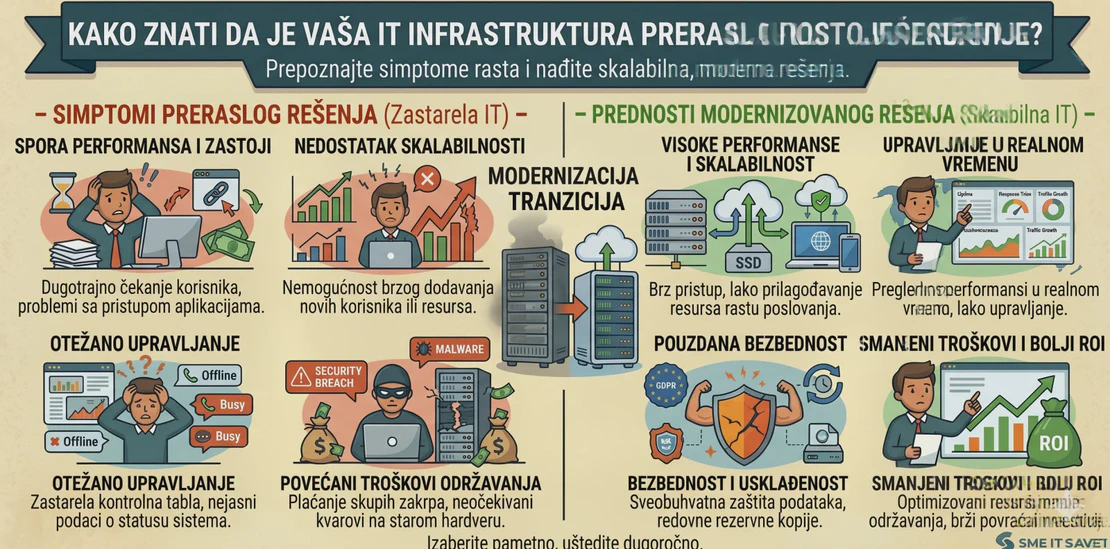

How to Know Your IT Infrastructure Has Outgrown Its Current Setup
IT infrastructure rarely becomes outdated overnight. It gradually becomes slower, harder to maintain, and less aligned with the way a company actually works. Computers still turn on, servers still run, and the network “mostly works” — but problems start appearing more often: users wait longer, applications slow down, backups take too much time, and every new change becomes a risk.
That is often the first sign that your infrastructure has outgrown its original setup.
Symptoms You Should Not Ignore
One of the most common indicators is declining performance. If employees regularly wait for applications to open, files to synchronize, or business software to respond, this is no longer just a technical issue. It directly affects productivity.
Another warning sign is constant patching. If problems are being solved temporarily — by adding another disk, another router, another improvised backup, or moving data “until a better solution is found” — your infrastructure probably no longer has a clear plan.
A third sign is difficult maintenance. When nobody is completely sure what is connected to what, where critical data is stored, who has access to which systems, and what would happen in case of failure, IT is no longer supporting the business properly. It becomes a potential risk.
Business Growth Requires a Different IT Approach
A solution that was good enough for five employees is often not suitable for twenty, fifty, or more users. The same applies to companies that have introduced remote work, multiple locations, cloud services, business applications, VPN access, or larger volumes of data.
At some point, simply adding more equipment is not enough. The entire environment must be reviewed: servers, workstations, network, security, backup, cloud services, licenses, and user support.
A well-designed infrastructure is not necessarily the most expensive one. It is the one that matches real business needs and can grow together with the company.
When Is the Right Time for an Assessment?
If problems keep repeating, if employees are working around existing procedures, if you are not sure that data can be quickly restored after a failure, or if you are planning business growth, it is the right time for a professional IT assessment.
Such an assessment does not automatically mean a large investment. Its goal is to determine what you already have, what works well, where the weak points are, and which steps should be taken first.
How Signet CS Can Help
Signet CS helps companies review their existing IT environment and make realistic, long-term decisions. With more than 20 years of experience in designing, implementing, and maintaining business infrastructure, we can analyze your servers, network, workstations, Microsoft environment, backup, and security mechanisms.
Our approach is not to immediately recommend the most expensive solution. Instead, we define what your business truly needs: what should be kept, what should be modernized, what should be moved to the cloud, and what should be planned for the future.
If you notice that your IT infrastructure is struggling to keep up with your business, the first step does not have to be buying new equipment. The first step is a professional assessment.
Signet CS can help you evaluate your current situation, define priorities, and build an infrastructure that will reliably support your growth.