
The Signet Team brings together engineers, consultants, and technical staff from Signet CS — a company that has been helping businesses …
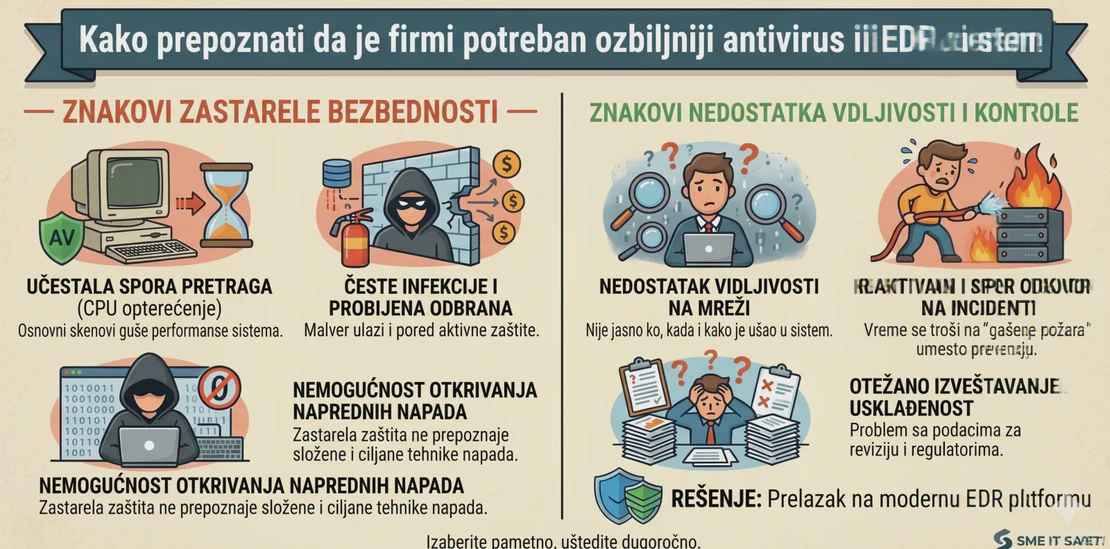

How to Know Your Company Needs a More Serious Antivirus or EDR System
Many companies still believe that traditional antivirus protection is enough to protect their computers. That may have been closer to the truth in the past, but today’s threats are much more complex. Attacks no longer come only through infected files. They come through phishing e-mails, compromised accounts, malicious links, remote access tools, macros, fake invoices, vulnerable applications, and legitimate system processes that are abused.
That is why EDR — Endpoint Detection and Response — is increasingly important.
When Is Antivirus No Longer Enough?
The first sign is lack of visibility. If you only know that “antivirus is installed,” but you do not know whether it is updated, whether it has detected anything, which devices have problems, or who reacts to alerts, your protection is probably too weak.
The second sign is remote work. Laptops used from home, while travelling, or on public networks are no longer behind the office firewall. They need protection that works regardless of location.
The third sign is the growing importance of data. If a company stores financial information, client data, contracts, project files, business documentation, or access to business applications, the consequences of an incident can be serious.
What Does EDR Do Differently?
Traditional antivirus usually tries to recognize and block known threats. EDR goes a step further: it monitors system behavior, detects suspicious activity, connects events, and enables faster response.
For example, if a process starts mass-encrypting files, runs a PowerShell script, contacts a suspicious server, or uses administrative tools in an unusual way, EDR can help detect the threat before it causes major damage.
Without Monitoring, There Is No Real Protection
It is important to understand that the tool itself is not enough. A security solution must be properly configured, regularly monitored, and connected to a clear response procedure.
Who receives the alert? Who checks the incident? Who isolates the infected device? Who checks whether the attack has spread? Who restores data from backup? These are questions a company must answer before an incident, not after it.
Which Companies Need EDR the Most?
EDR is especially important for companies with multiple employees, remote work, access to business applications, sensitive data, servers, Microsoft 365 environments, or a history of frequent phishing attempts.
It is also important for companies that do not have internal IT staff continuously monitoring security events. In that case, support from an external IT partner can make a major difference.
How Signet CS Can Help
Signet CS helps companies assess their current level of protection and choose the right security solution. This may include traditional antivirus, EDR, firewall, VPN, e-mail protection, MFA, backup, security assessment, and user training.
Our goal is not only to install software, but to create a meaningful security system: endpoint protection, proper policies, monitoring, incident response, and employee education.
If you are not sure whether your current protection is sufficient, that is already a good reason to check.
Signet CS can perform a security assessment, recommend the right endpoint and EDR solution, and help you protect your computers, users, and business data.